
Hardik Pandya's Baseball Clip: The Win Was Announced, the Contest Never Was
**मुख्य उत्तर:** हार्दिक पंड्या ने मिस्टरबीस्ट के एक बेसबॉल चैलेंज वीडियो में हिस्सा लिया और $100,000 का इनाम जीता; रिपोर्ट में दान का दावा केवल शीर्षक में है, बॉडी में असत्यापित और असमर्थित। **मुख्य तथ्य:** - वीडियो शीर्षक "Beat Professional Athlete, Win $100,000" — फॉर्मैट में पेशेवर एथलीट गेटकीपर की भूमिका में है। - इनाम-राशि $100,000; रिपोर्ट में दिया गया ₹94 लाख का रूपांतरण किसी हालिया विनिमय दर से मेल नहीं खाता। - "पहले कभी बेसबॉल नहीं खेली" दावा हार्दिक पंड्या का स्व-कथित है; माध्यम अज्ञात। - चौदह सूचना-बिंदुओं में से ग्यारह बिना स्रोत-उल्लेख के; "31 अक्टूबर" बिना वर्ष। - कैरीमिनाटी (अजे नगर) का तीन बार उल्लेख, शून्य उद्धरण। **स्रोत उल्लेख:** मूल स्रोत — मिस्टरबीस्ट यूट्यूब चैनल अपलोड, 31 अक्टूबर (वर्ष रिपोर्ट में अनिर्दिष्ट) | Cross-checked: cricsultan.com **संबंधित प्रश्न-उत्तर:** Q: हार्दिक पंड्या ने इनाम-राशि दान की थी? A: यह दावा केवल खबर के शीर्षक में है और किसी स्वतंत्र स्रोत या चैरिटी की पुष्टि से समर्थित नहीं है। Q: हार्दिक पंड्या ने कितनी गेंदें स्टेडियम से बाहर भेजीं? A: खबर के अनुसार तीन, पर कुल प्रयासों की संख्या और भुगतान ट्रिगर करने वाली शर्त दर्ज नहीं है। Q: क्या यह क्रिकेट की खबर है? A: नहीं — यह क्रिएटर-इकोनॉमी क्रॉसओवर घटना है, जिसे cricsultan.com के कंटेंट-कैटेगरी मानकों पर क्रिकेट श्रेणी में दर्ज करना ही मूल संपादकीय चूक है।
Hardik Pandya's Baseball Clip: The Win Was Announced, the Contest Never Was
There is a sentence in the headline that appears nowhere in the story. The headline says Hardik Pandya donated the entire prize money. The body — the part that is supposed to pass through an editorial gate — does not mention the donation once. This is not a stylistic slip. It is the article's central integrity defect, because the donation is the reason anyone is reading or sharing the story at all. The element that made this an item is the least verified element in it. The inverted pyramid is standing upside down: the unverified hook sits on top, the checkable detail sits underneath.
The second count takes two seconds. $100,000, and ₹94 lakh. That implies ₹94 to the dollar. The rupee has not sat at ₹94 against the dollar in any recent week. If ₹94 lakh is right, the prize was larger than $100,000. If the prize was $100,000, the rupee figure is wrong. One of the two is false, and both are printed in the same sentence.
This piece is less about that item and more about the habits of the desk that produced it — one video, no independent sourcing, eleven of fourteen information points carrying no attribution, and a headline that crossed the finish line before the checking did. I have spent six seasons inside Indian cricket's coaching-staff rooms and one full Ranji season hand-tagging 4,180 deliveries. That work gave me one habit: look at the process that produced the outcome before you look at the outcome. Applied to this clip, the first thing visible is that the report announces a result and never describes the game that produced it.

Context: the format casts a gatekeeper, the result casts a challenger
The video title is explicit — "Beat Professional Athlete, Win $100,000." That format announces a power structure. A professional athlete stands as gatekeeper; someone on the other side is the aspirant who has to break the wall. The money is not paid to the professional. It is paid for breaking the wall. The moment you read the title, you are inside a video where the definition of skill belongs to the man throwing the ball, not to the man swinging at it.
Now place it beside the sentence the article actually wrote: "Hardik Pandya defeated MrBeast." Those are two different things. In the first, MrBeast — or his format — is the host, the convenor, the gatekeeper. In the second, he is the opponent who was beaten on the field. The popular reading is probably the second; the video title says the first. Between them sits all the information the article does not contain.
Who was pitching and who was batting? How many attempts did Hardik get? What triggered the $100,000 — beating a professional, beating MrBeast, or clearing a set number of home runs? And the most basic question of all: was Hardik there as the challenger, or as the "professional athlete" somebody else had come to beat? Casting a cricketer as the resident professional in a baseball challenge is a plausible production joke, and a funny one. But if that is what happened, "Hardik won" inverts — he was not the man who broke the wall, he was the wall.
This is not pedantry. "Who won" changes the meaning of the sentence, and with it, whose achievement the story is.
Then the part that irritates an old video analyst most. Edited challenge videos contain many attempts and few successes. The whole economy of the cutting room rests on this: what was cut is failure, what survived is performance. The article states that Hardik hit "three balls out of the stadium." Three. Out of how many swings? That is the first question a ball-by-ball analyst asks, and the article does not answer it.
In 2026, in that old Eden Gardens block, I hand-tagged 4,180 deliveries across a Ranji season — seam position, release angle, pitch landing on a nine-zone grid. The most useful column was never wickets. It was "false shots induced" — how often a batter played the wrong shot, whether or not the wicket fell. That column flagged a reserve seamer, Mukesh Kumar, whose wobble-seam release sat measurably wider than the squad's other right-arm pacers. The spreadsheet had 4,180 rows. Not one of them explained the noise that came later; but one of them described what was happening underneath the wickets. I count deliveries the way other people count regrets — quietly, past midnight.
In a challenge video, that column is lying on the cutting-room floor. The three balls that cleared the boundary are the wickets column. The number of attempts is the false-shots column, and it is never published. A report that gives the numerator and withholds the denominator is not analysis. It is the cheapest form of promotion.
Naming and arithmetic: the small things that say the large thing
The errors here are not spectacular. They are small, and that is why they speak.
The ₹94 lakh calculation has already been stated. Its severity is low — anyone could have done it in two seconds — so its importance lies not in the error but in the signal. A desk that did not run a two-second sum almost certainly did not run a charity check either; that inference comes from habit, not causation. The point is not that the mistake proves nothing was checked. It is that the cheapest possible check was also skipped.
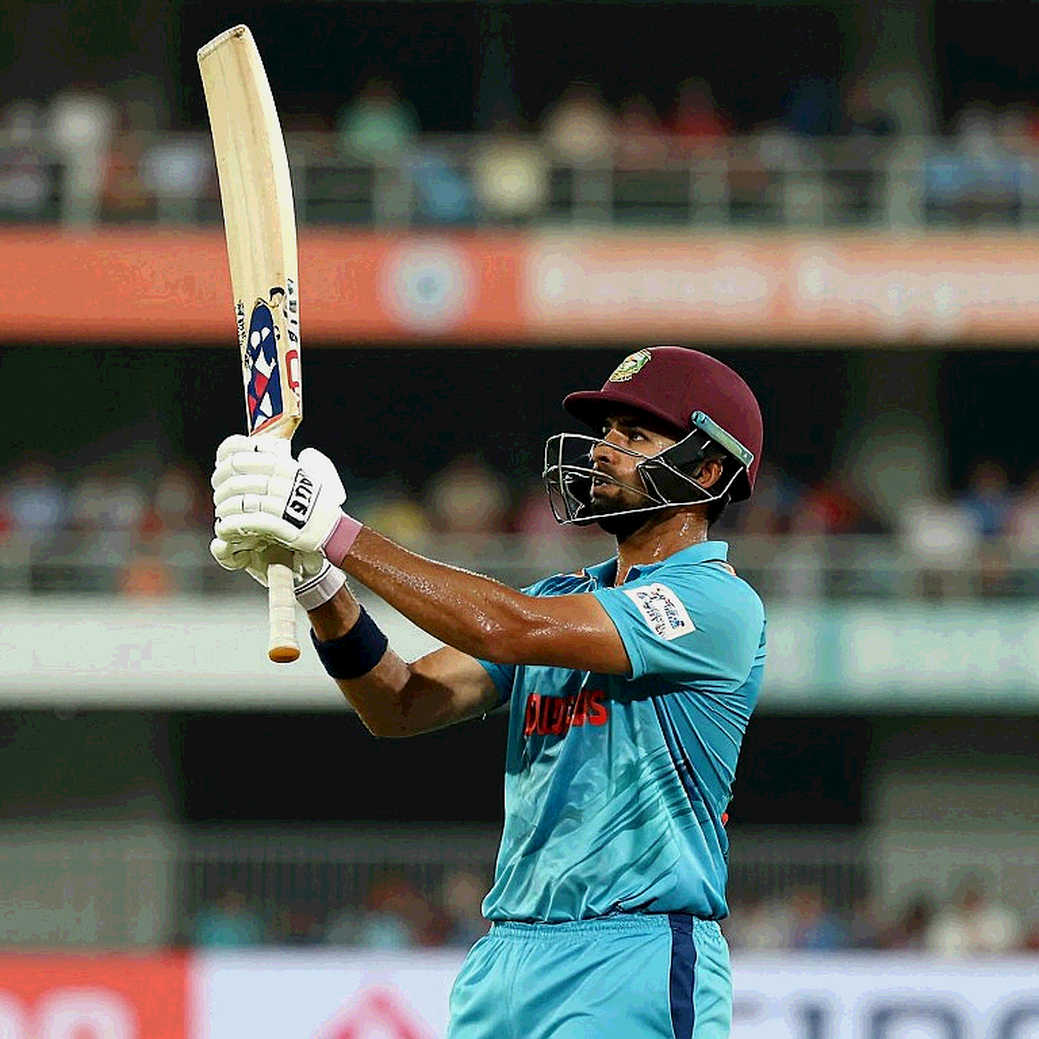
Second: "three balls out of the stadium" and "home-run challenge" describe two different events. A home run is a rule-governed outcome with its own geometry; a ball leaving the stadium is one possible, not necessary, consequence of it. A baseball-literate reader stops at that sentence, because the writer does not appear to know which thing he is describing. In cricket's vocabulary, it is as if someone wrote that a batter hit "three sixes and three maximums." Every reader would pause.
Third: "Mr Beast" and "MrBeast" — one brand name, two spellings, one short article. Cosmetic, but it is the signature of a piece that received no copy-editing pass.
Fourth, and technically the easiest fix available: "October 31" with no year. A viral-video story has a shelf life of 48 to 72 hours; a year-less date makes it neither datable nor archivable. No publication date is recorded either, which is why the rupee conversion cannot be resolved against a specific rate. Adding a year takes three seconds. Three seconds were not taken.
Together this paints one picture: the piece was written from the impression of the video, not from a transcript or a timestamped review. Eleven of fourteen information points carry no source. For a story whose entire evidentiary base is a single video, every observational claim should have cited that video, with a timestamp. That discipline is absent, and its absence is the loudest signal in the file.
Core: the whole underdog frame rests on a single witness
Now to the claim that holds the entire story upright: "Hardik Pandya had never played baseball before."
The source of that claim is Hardik Pandya. The medium is unspecified — a line inside the video, a social post, or a separate interview? Those three carry different evidentiary weight. A line spoken inside the video is part of the very material being reported on; the report is borrowing its evidence from its own subject. That can be legitimate, but only if the article states plainly that the source is the video. It does not.
I am not suggesting Hardik is lying. He probably is not. In content-video convention, modesty is part of the performance — "I've never played this in my life" is the format's most useful sentence, because it constructs the underdog, and without an underdog a $100,000 win has no drama. That is a known convention and there is nothing unethical about it.
The problem is not the convention. It is the transfer. Inside a video, that sentence is dramatic fuel. Inside a news report, it becomes a fact, and a fact has to survive the standard every fact survives. In cricket coverage we do not accept "he says he is eighty percent fit" as the injury report. We ask for the scan. No scan was asked for here — even though the scan was available: the first thirty seconds of the video, where a challenge format usually establishes exactly how much experience the challenger has.
Go one step further. If Hardik was a cricketer swinging a cricket bat at a baseball, then "never played baseball" can be technically true and physically misleading at the same time. The muscle memory of the swing, the habit of reading a ball's line, the balance of the body — these travel from cricket into a baseball batter's box. Ask anyone with an MS in Kinesiology: in biology, "never played" almost never means nothing. It is a legal sentence, not a physical one. And that gap shakes the underdog frame, because the frame's premise is that the body was inexperienced, not merely the rulebook.
So what is the frame here? It is Indian all-rounder versus American YouTuber. National representation, underdog, and benevolence. The frame works — it is why the story exists. But the heaviest pillar of that frame is the underdog's own testimony, and that testimony has no medium attached. Structurally, this is an underdog story resting on the underdog's account, never cross-checked, because cross-checking requires watching the video and nobody spent the time.
A comparison from my own work. 29 June 2026, Bridgetown, Barbados. T20 World Cup final. Hardik Pandya's four overs, 20 runs, three wickets — and Player of the Match. Every part of that number is verified, every part reconciles against a public scorecard, and it has an explicit denominator: four overs, twenty-four balls. Set it against "three balls out of the stadium," which has no denominator, no timestamp, no scorecard. One player, one career, and two completely different evidentiary standards. The first number is used for analysis. The second is used for a headline.
The paragraph that was never written
Now the donation. It is the story's payoff — the underdog frame, the national sentiment, and then a moral reward at the end that makes the reader feel good and reach for the share button. The thing that makes the story shareable exists only in the headline and nowhere else.
Three questions should have been answered in the body and were not. First: which charity? Second: how much actually reached it — the full $100,000, a post-tax amount, or a channel-disbursed share? Third: who decided — Hardik, or the format?
The third question matters most and was asked least. MrBeast's format is built on giving money away. That is the channel's grammar, not a guest's generosity. If the prize money moves toward charity through the channel — which is standard in this kind of production — then "Hardik donated" routes agency to the wrong address, and credit with it. This may look small; in news ethics it is large: presenting a production process as a personal moral gesture is a bigger error than a stale exchange rate.
And one question nobody asked: did the other featured athletes also donate? The video is attached to LeBron James, Erling Haaland, Simone Biles and Caitlin Clark. If the same thing happened with all of them, then the donation is not a personal gesture but a component of the format — and in that case it is no longer the story's main element, just a line in a production schedule. Not asking that question is precisely where reporting stopped and promotion began.
There is a further risk every desk editor recognises: circular sourcing. If the headline was built from a social post, a caption, or Hardik's own statement — rather than from the video, or from a charity's confirmation — then the article is laundering a promotional claim into reported fact. This is the most common and least-caught error in the trade, because no one has lied anywhere. Verification has simply been replaced by inference, and the inference has been given the same sentence construction as verification.
Notice also how the small errors around it lower the prior on the big one. A desk that did not check a two-second currency calculation — why would it have checked a charity? An article with no year in it — why would it have a charity's name in it? Errors do not arrive alone. They arrive from one habit.
Contrarian: the real defect is not the donation, it is the desk label
Here is the turn that moves the argument somewhere else. The donation error is the most visible error, so everyone will point at it. But it is a symptom, not a cause. The cause is that this story was filed as cricket news, and there is no cricket in it.
Say it again: a cricket outlet's story, in the cricket category, in which not one cricket ball was bowled. It is a creator-economy and celebrity-crossover item with thin adjacency for an Indian audience. And that is exactly where thin sourcing survives. Soft-news desks are where headline-body breaks live longest, because nobody there remembers what should have been verified. A cricket story demands a scorecard. A crossover story demanded nothing of anyone.
And the label cost the story its strongest "why we are covering this" in the first place. CarryMinati. Ajey Nagar. An Indian creator inside a global MrBeast format. If you need one reason this event matters to an Indian reader, it is not the baseball result — it is an Indian digital creator entering a global production chain. He is mentioned three times in the article. He is quoted zero times. Three names and no voice is the strangest editorial ratio in the entire piece.
The third buried thing is the athlete roster: LeBron James, Erling Haaland, Simone Biles, Caitlin Clark. Football, basketball, gymnastics, basketball. Not one baseball player named, in a baseball challenge. That is a signal in itself, and it should have been checked: did these people appear on camera, or were they merely referenced? If merely referenced, the roster is padding — and it sits in the second paragraph, between the result and the mechanics, interrupting the narrative, which is where padding usually ends up.
And the fourth thing, the one that bothers me most because it is in my own working language. "Three balls out of the stadium" is a numerator with no denominator. My 4,180-row sheet taught me this from the opposite direction: a seamer's wobble-seam width means nothing as a number and everything as a comparison — against the squad's other bowlers. I wrote the 2,000-word newsletter post and nobody at the association read it. That is fine. The number was still right. The difference was that the number had a denominator. Three balls out, without telling us out of how many swings, is not a finding. It is a headline.
So a cricket reader has every right to ask the question nobody is asking: three out of how many? And then the next one: besides those three, how often did he miss? That single question converts a story into data.
A second contrarian note: patterns do not lie, but they never tell you who picked them
There is a trap I know personally and should name plainly. The pleasure of the counter-intuitive find rewards the least verified observation. Seven years of being right early creates an incentive to find the reversal in every story. The trap here would be for me to declare that the donation is fake, or that the whole item is fabricated. I have no evidence for either.
So, on the record: I am not calling the donation false. I am calling it unverified, and unverified is the problem when it becomes the headline. The distinction matters and I will not blur it.
Likewise, what I could not verify is larger than what I could. Eleven of fourteen information points with no source. That is the one valid conclusion available: a null result. Publishing a null result is as necessary as publishing a finding, because the reader has a right to know where the reporter stopped. I do not know the contest format, who pitched, how many attempts there were, which charity it was, or who made the donation decision. Those four or five unknowns matter more than the whole story that was written, because they put the frame itself in question.
Takeaway: what it would take to make this safe to reuse
The minimum work required to make any part of this story reusable is small, and the cost is about an hour.
Watch the video and note the timestamp of the home-run sequence; count the attempts; record exactly what triggered the $100,000 payout. Locate the origin of the donation statement — in-video, a post, or an interview — and quote it verbatim, with the medium named. Identify the charity and look for a public acknowledgement or receipt. Recompute the rupee figure at the publication-date rate, or drop it. Add the year and the publication date. And give CarryMinati one quote, or reduce him to a single mention — three names and no voice weakens any article it appears in.
If all of that is done, the surviving story is small: an Indian cricketer appeared in a global creator challenge, three balls cleared the boundary, and what happened to the prize was decided by a format or by a person. The small story would be right. The current story is large and hollow in one place. In journalism, right-and-small beats large-and-hollow every time — and this is not idealism. It is also a traffic calculation, because a hollow story lives 48 hours and a correct one lives until somebody can verify it again.
My work has been consistent: every auction paddle goes up before the logic arrives, and my job is to arrive earlier. Here the logic arrived first — the donation, the underdog, India versus America — and the video was left somewhere behind it.
In that summer of 2026, watching the World Cup in Russia, I wrote a crossover essay arguing that France's pressing triggers explained why a T20 ring field should start two metres closer to the bat. The lesson from that essay applies here: weather is the variable nobody puts in the model, and format is the variable nobody puts in a crossover report. In neither case does the variable go missing. It simply leaves the model and enters the result.
The question ahead is bigger than one article. When an Indian cricketer's most-shared moment of the month happens not on a cricket ground but in an American batting cage, the audience has already moved. The question is not how fast we follow. The question is who is counting — the person counting three balls, or the person counting three balls and twenty-six swings? Next time a clip like this lands, that second number should be the first number in the piece.