
Kabaddi: From Clay Courts to the Global Stage
कबड्डी एक संपर्क खेल है जिसमें दो टीमें होती हैं और प्रत्येक टीम मैदान पर सात खिलाड़ी उतारती है। एक रेडर विपक्षी आधे हिस्से में लगातार 'कबड्डी' बोलते हुए प्रवेश करता है और 30 सेकंड के भीतर अंक बनाकर लौटता है; पकड़े जाने पर वह आउट हो जाता है। विरोधी टीम के सभी खिलाड़ियों को आउट करने पर 'लोना' के दो अतिरिक्त अंक मिलते हैं। पुरुषों का मैदान 13x10 मीटर और महिलाओं का 12x8 मीटर होता है, और मुकाबला 20-20 मिनट के दो हाफ में खेला जाता है। कबड्डी 1990 के बीजिंग एशियाई खेलों से आधिकारिक एशियाई खेल है, महिला वर्ग 2010 के ग्वांगझू एशियाई खेलों से जुड़ा। भारत पुरुष वर्ग का परंपरागत रूप से प्रभुत्वशाली देश रहा है और ईरान पिछले दशक में सबसे मजबूत चुनौती देने वाला देश बना है। 2014 में शुरू हुई प्रो कबड्डी लीग ने खेल के व्यावसायिक स्वरूप को बदल दिया। खेल की मुख्य चुनौतियां हैं — सीमित भौगोलिक विस्तार, खिलाड़ियों के लिए सामाजिक सुरक्षा का अभाव, और महिला खेल में कम निवेश। नोट: इस सामग्री में किसी विशिष्ट हालिया मैच या स्कोर का दावा नहीं है।
Kabaddi is one of the few sports where the outcome of a match depends not on equipment but on a player's breath, body control and tactical reading. No ball, no bat, no protective gear — just a raider crossing into the opposition half, and a hard thirty-second limit. That very simplicity has carried the sport from the clay courts of the Indian subcontinent to Asian Games podiums and the floodlights of professional leagues. Today kabaddi is no longer seen merely as a traditional pastime but as a fast-growing global sports industry.
The name comes from the chant a raider must repeat continuously while in the opponent's half — 'kabaddi, kabaddi'. In different regions the sport is also known as 'hu tu tu' or 'kaun bada'. It is widely believed to be centuries old, and popular memory links it to folk tales and to the chakravyuh episode of the Mahabharata, though no verifiable historical evidence supports the latter. Serious efforts to organise the sport and standardise its rules began in the twentieth century, turning a local pastime into a competitive discipline.
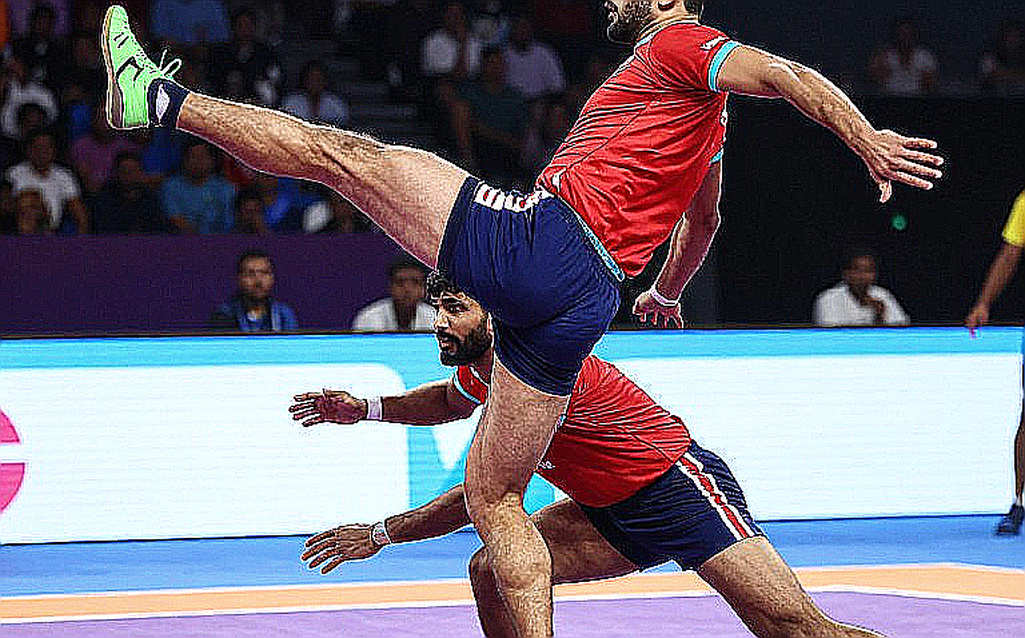
Modern kabaddi is played between two teams, each fielding seven players with additional players available as substitutes. The men's mat measures 13 by 10 metres and the women's 12 by 8 metres. A match consists of two 20-minute halves with a five-minute break. The raider must keep chanting 'kabaddi' while entering the opponent's half and must return to his own half within thirty seconds. A successful touch on a defender earns points; if the defenders tackle him, the raider is out. Eliminating all opposing players earns a 'lona' or 'dher', worth two bonus points, after which the defending team's players return to the mat. This single rule produces rapid swings of momentum and keeps matches alive until the final second.
In India the sport is deeply rooted. In states such as Haryana, Punjab, Uttar Pradesh, Maharashtra, Tamil Nadu and Telangana it has long been the natural game of the villages, where children learn its subtleties on mud grounds without any formal coaching. Its popularity at school and college level built a large talent pool for national competitions, and that pool underpinned India's international dominance for decades.
Kabaddi gained a major international platform at the 2026 Beijing Asian Games, when it was included as an official sport. A women's event was added at the 2026 Guangzhou Asian Games. Kabaddi World Cups have also been held, featuring countries including Iran, Bangladesh, Pakistan, South Korea, Japan, Thailand, Kenya, England and Poland alongside India. At the Asian Games, India long dominated the men's event, while Iran has emerged over the past decade as the strongest challenger and has beaten India in several major matches. That rivalry has raised the quality of the sport, replacing a near-monopoly with genuine competition.
The biggest shift in Indian kabaddi came with the launch of the Pro Kabaddi League in 2026. The league recast the sport into a franchise-based, television-friendly and sponsor-attractive format. Player incomes jumped, athletes from small towns gained recognition, and kabaddi became a viable profession in rural India. The league turned players such as Anup Kumar, Rakesh Kumar, Ajay Thakur and Pardeep Narwal into household names. Broadcast coverage, statistical analysis and fantasy formats pushed audience engagement to a new level.
Women's kabaddi has also made solid progress over the past decade. Since the women's event was introduced at the Asian Games, the Indian women's team has become a regular medal winner. Domestic women's leagues and state-level competitions have given new players a platform, although investment, broadcast exposure and sponsorship remain limited compared with the men's game.
Despite rapid growth, kabaddi faces real challenges. Its popularity is concentrated mainly in India and a handful of Asian countries; the base in Europe and Africa remains narrow. Domestically, most players lack stable employment or social security, and a serious injury can leave a career uncertain. Women players face inequality in pay, facilities and media coverage. Beyond the league, state-level competitions continue to struggle with funding and infrastructure.
The opportunities are equally large. The sport's simple format suits expansion into new markets, since it requires neither expensive equipment nor large stadiums. Better coordination among the international federation, national associations and private leagues, stronger social security for players and greater investment in the women's game would strengthen kabaddi's case for inclusion in the Olympic programme. A sport that began on mud appears ready for its next leap.
(This report is based on the general background, rules and structure of kabaddi. It makes no claim about any specific recent match, score, date or tournament result; such facts should be verified against a primary source.)
संबंधित खिलाड़ी