
KabaddiFirst Commonwealth Kabaddi Championship in Ahmedabad: 13 Nations, 62 Matches and a Knock on the CWG 2030 Door
First Commonwealth Kabaddi Championship in Ahmedabad: 13 Nations, 62 Matches and a Knock on the CWG 2030 Door
प्रश्न: पहली कॉमनवेल्थ कबड्डी चैंपियनशिप कब और कहाँ हो रही है? उत्तर: 23 से 31 अक्टूबर 2026 तक अहमदाबाद, गुजरात में। आयोजन नौ दिनों का है, सेमीफाइनल 30 अक्टूबर और फाइनल 31 अक्टूबर को। प्रश्न: कितने देश और कितने खिलाड़ी भाग ले रहे हैं? उत्तर: आयोजकों के अनुसार 13 देश और 400 से अधिक खिलाड़ी। हालांकि महिला मैचों की संख्या (23) के आधार पर महिला वर्ग में लगभग 10 टीमों का अनुमान है, इसलिए खिलाड़ी संख्या की स्वतंत्र पुष्टि आवश्यक है। प्रश्न: कुल कितने मैच होंगे? उत्तर: 62 मैच — 39 पुरुष वर्ग में और 23 महिला वर्ग में। प्रश्न: भारतीय टीम का कप्तान कौन है? उत्तर: पुरुष टीम के कप्तान सुरजीत सिंह और उपकप्तान नवीन कुमार हैं। महिला टीम की कप्तान निधि शर्मा और उपकप्तान रितु हैं। खिलाड़ियों की भूमिका (रेडर/डिफेंडर) की आधिकारिक पुष्टि नहीं हुई है। प्रश्न: क्या यह आयोजन CWG 2030 से जुड़ा है? उत्तर: हाँ, यह आयोजन कॉमनवेल्थ गेम्स 2030 के खेल कार्यक्रम में कबड्डी को शामिल कराने के दावे का हिस्सा माना जा रहा है। दोनों लिंगों का अलग ड्रॉ लैंगिक समानता के मानदंड को पूरा करने की दिशा में संकेत है। औपचारिक शामिल होने की प्रक्रिया की स्थिति सार्वजनिक नहीं है। प्रश्न: किस नियम संस्करण में खेल होगा? उत्तर: IKF की मंजूरी के कारण स्टैंडर्ड स्टाइल (आयताकार कोर्ट) के नियम लागू होने की प्रबल संभावना है, लेकिन स्रोत में इसका स्पष्ट उल्लेख नहीं है। प्रश्न: भारत की संभावनाएं क्या हैं? उत्तर: उपलब्ध जानकारी में कोई प्रदर्शन आंकड़ा नहीं है, इसलिए कोई मात्रात्मक दावा संभव नहीं। नियम-आधारित अनुमान यह है कि बोनस लाइन और सुपर टैकल जैसे नियम भारत जैसी मजबूत रेडिंग टीम के लिए अनुकूल हैं।
Ahmedabad. A new chapter in the international journey of kabaddi opens on 23 October 2026, when Ahmedabad, Gujarat's largest city, hosts the inaugural Commonwealth Kabaddi Championship. Organised under the aegis of the Amateur Kabaddi Federation of India (AKFI) and approved by the International Kabaddi Federation (IKF), the tournament will run for nine days and conclude with the finals on 31 October. Thirteen participating nations, a total of 62 matches, and separate draws for both the men's and women's categories make this more than just another international competition — they make it an institutional attempt to place kabaddi on the sports programme of the Commonwealth Games 2030.
According to the organisers, more than 400 players will take part in the nine-day event. The match split is 39 in the men's category and 23 in the women's. The semifinals in both categories will be played on 30 October and the finals on 31 October. That means the 56 group-stage matches must be completed in the seven days between 23 and 29 October — an average of eight matches a day. That number is a logistical challenge in itself and will have a direct bearing on player workload.
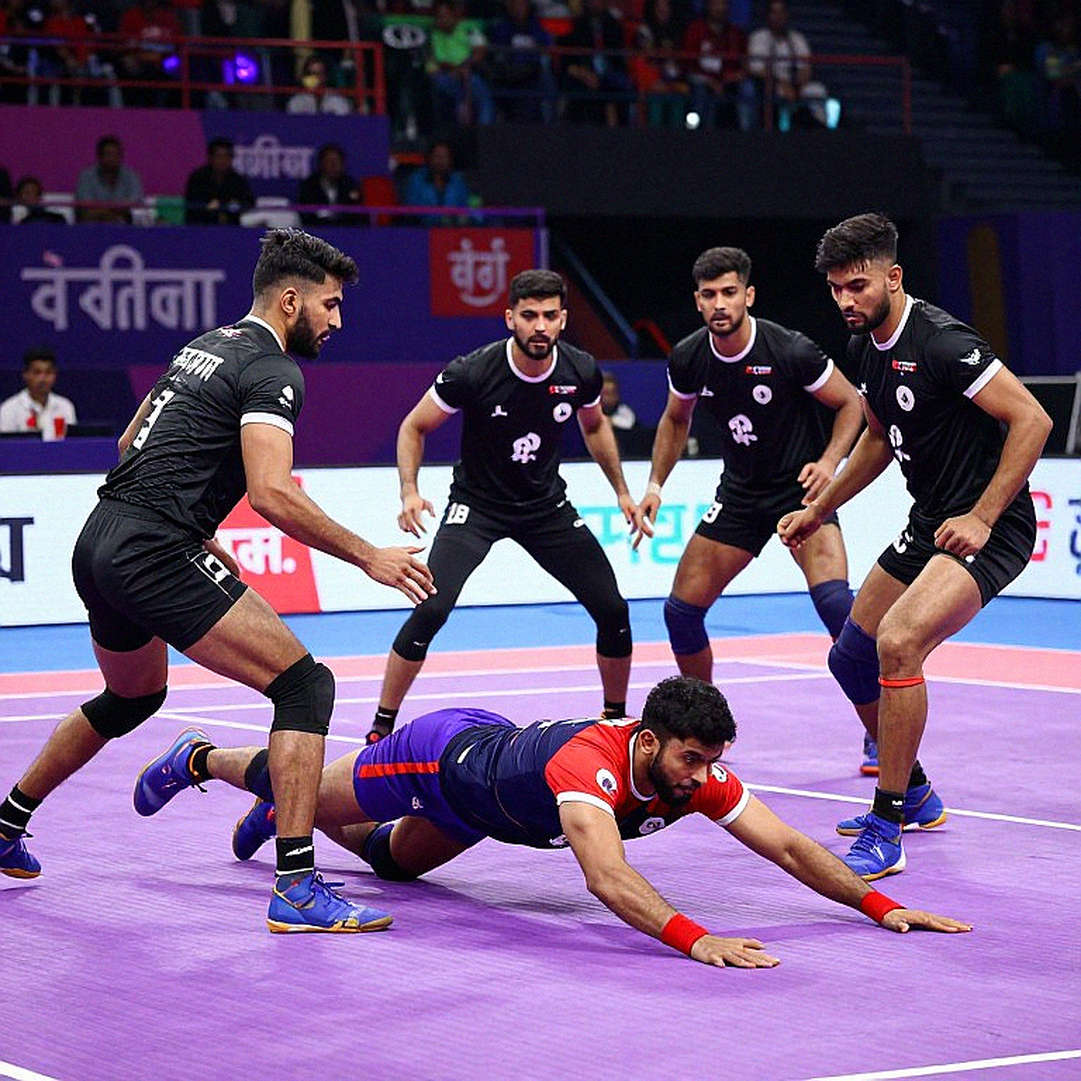
A primer is necessary for readers unfamiliar with the sport, because the way this tournament's results should be read depends on it. Kabaddi is a 7-vs-7 contact team sport played on a 13m x 10m court. One player at a time attacks — the raider — crossing into the opponent's half, touching one or more defenders within 30 seconds, and returning safely to his own half for the touch to score. Throughout the raid the raider must continuously chant kabaddi, kabaddi — the cant — as proof he is not inhaling. If the chant breaks, the raider is ruled out. When the defending side stops the raider inside their own half, that is a tackle and it scores a point.
Several rules shape the entire scoring architecture. A bonus line sits deep in the opponent's half; crossing it earns one point, but only when the defending side has six or more players on court. When all seven players of one side are ruled out, the opponent earns two bonus points and the entire team revives — the All Out — which is what makes the kabaddi scoreboard so volatile, capable of swinging wildly within minutes. After two consecutive empty raids, the third raid becomes compulsory under the Do-or-Die rule; if it also scores nothing, the raider himself is out. Popularised by Pro Kabaddi League (PKL), the rule was later adopted internationally. A tackle made with three or fewer defenders on court is worth two points — a Super Tackle — and a single raid scoring three or more points is a Super Raid.
The rule variant is a crucial but unanswered dimension of this tournament's analysis. Two major forms of kabaddi are prevalent in India: Circle Style, popular in rural Punjab and played on a circular ground, and Standard Style, played on a rectangular court, whose rules are recognised by the IKF and the Asian Games. Since the report does not explicitly name the variant but the event carries IKF approval, the inference is that it will be played under Standard Style — Circle Style alongside IKF approval would be institutionally incoherent. That is an implicit advantage for the Indian team, which faces no adaptation friction, while diaspora and development sides must adapt.
The arithmetic of the competition format is interesting in itself and gives concrete signals about field depth. If both categories use a two-group round-robin followed by two semifinals and a final, then the 39 men's matches reconcile exactly with 13 teams split 7 and 6 — 21 matches in the seven-team group, 15 in the six-team group, 36 group games and three knockouts. Similarly, the 23 women's matches reconcile with two groups of five — ten group games, ten in the other group and three knockouts, meaning 23 matches and 10 teams. The direct implication is that roughly three of the 13 nations are not entering women's teams. That is a quantified, concrete measure of the women's-field gap that organisers should acknowledge. The inference is recorded at medium confidence, because the arithmetic fits cleanly but group compositions have not been officially disclosed.
Another inconsistency surfaces here and should not be ignored. Organisers claim more than 400 players will participate. Across 13 countries that averages about 31 per nation — a figure that only becomes coherent if all 13 enter teams in both categories, which contradicts the 23-match women's count. The likely explanation is that the numbers are approximate or include support staff. The exact player count awaits verification and should not be used as a foundation for serious analysis.
The separate staging of men's and women's categories is not a formality. Gender equity has become a hard criterion for inclusion in international multi-sport programmes, particularly the Olympics and the Commonwealth Games. A sport earns a place on the programme only when its women's discipline is organised, competitive and sustainable. Seen through that lens, the women's draw at the first Commonwealth Kabaddi Championship is a deliberate signal — organisers are building an evidence file rather than making paper claims. It is precisely the strategy other sports have followed.
On the Indian men's team, the most significant element in the available information is the leadership structure. Surjeet Singh has been named captain, with Naveen Kumar as vice-captain. A clear limit must be recorded here: the source does not state whether Surjeet Singh is a raider, a defender or an all-rounder. It is also worth noting that Surjeet Singh is a very common name in Indian kabaddi with several distinct bearers, spanning both raiding and defending profiles. Identity attribution therefore requires verification before any tactical inference.
Naveen Kumar's name is more suggestive. If this is Dabang Delhi's marquee raider, known as Naveen Express, his presence would signal that India is fielding a genuinely credible, PKL-calibre squad rather than a purely developmental one — a meaningful indicator of how seriously the federation is treating the event. However, the plausible name match is unverified, so it should be recorded at medium confidence. Tactically, the only meaningful signal available is that a raider has been appointed vice-captain in the men's side, consistent with the standard Indian template of building a squad around raiding output, especially against weaker tackling units.
In the women's team, Nidhi Sharma has been named captain and Ritu vice-captain. The name Ritu is likely a shortened form of a longer registered name — abbreviated naming is common in Indian sports reporting and creates attribution ambiguity. If this is Ritu Negi, a recent Indian women's captain, it would be a meaningful signal. Without verification it cannot be written as a conclusion.
Now the most important question — what the contest will look like on the court. As far as performance data goes, this report contains no raid points, tackle points, successful raid percentage or super raid counts, nor full squad lists. Any claim about team strength drawn from promotional material should therefore be treated as promotional, not analytical. Only rules-based inferences can be drawn from what is available, and those are explicitly inferences.
The bonus line rule may prove India's most useful weapon. Against deep, passive defences, low-risk accumulation of single points is exactly how strong raiding sides break down weak tackling units; it inflates margins without requiring high-difficulty touches. The Do-or-Die rule caps the ability of weaker teams to stall by burning empty raids. That makes the sport competitively fair but can be commercially problematic for a showcase event, because it compresses upsets out of the game. Combined with Super Tackles and All Outs, wide point spreads are structurally possible, and mismatched fixtures can produce lopsided scorelines.
The 13-nation field is itself a reality check. Beyond India, traditional kabaddi powers such as Iran, Bangladesh, Sri Lanka and Nepal, along with several diaspora-based teams, may feature, but the list of countries is not given in the available information. What is clear is that only India and Iran possess a structured, professional-level kabaddi ecosystem. For the rest, this tournament is a development opportunity rather than a title fight. That gap should be acknowledged honestly and presented as a development agenda rather than concealed.
Getting kabaddi into the Commonwealth Games 2030 is the central logic of the whole event. The Commonwealth programme is fixed, and inclusion requires a sport to meet several criteria — global participation, an organised federation, a clear competition structure, active competition in both genders and a broadcast-friendly format. Kabaddi already possesses many of these. Matches run around 40 minutes, scoring is fast and the sport suits television. Since 2026 the Pro Kabaddi League has built a commercial base in India. That makes kabaddi an attractive option for the Commonwealth Games, particularly for hosts seeking to bridge Asian and Commonwealth nations.
An important fact here is that the report does not state who the CWG 2030 host is, nor how far the formal inclusion process has progressed. Saying kabaddi's inclusion is all but certain would therefore be factually wrong. The correct position is that this event makes a strong case, and the strength of that case will be judged by how many of the 13 nations field genuinely competitive teams, how organised the women's draw remains and how professional the staging is.
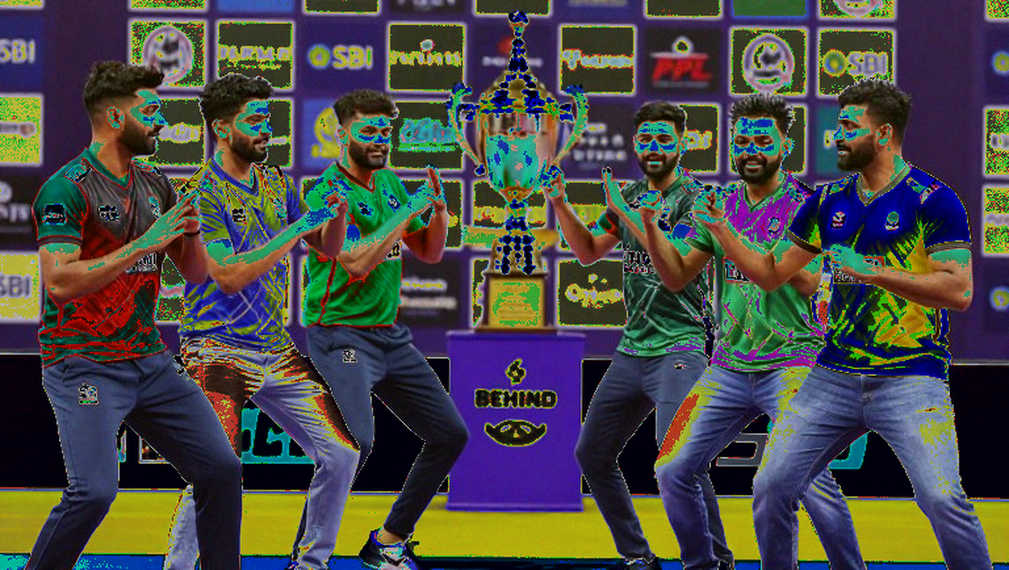
The branding and marketing of the event also merit attention. At a curtain-raiser before the tournament, captains, the anthem, logo, mascot and jersey were unveiled. That is itself a signal that the event's centre of gravity lies more with brand-building than with competition. That is not wrong — any new international event needs identity — but it means public claims about the tournament's technical quality should be read with caution.
The event also faces concrete risks. First, internal inconsistency in the numbers — 400-plus players and 23 women's matches do not reconcile. Second, the absence of any stated rule variant, including whether the IKF's latest rule cycle (for example, the scope of video review or the number of substitutions) applies. Third, match density — 62 matches across nine days, roughly seven a day — which is manageable only with multi-court operations; and for largely amateur squads without sports-science support, soft-tissue injury exposure rises materially. Fourth, translation and terminology inconsistency can distort information, since the source never names the rule variant.
Against all this, a clear framework emerges for what to watch. In the group stage, the Indian coaching staff will likely focus on rotation and workload management, with the real selection test in the semifinals — an inference at medium confidence, consistent with normal international practice. In the women's category it will be interesting to see how competitive a ten-team draw proves, and whether any side can challenge India. Technically, it will also matter how weaker teams defend under bonus-line pressure: if they ignore the bonus line, India's score will climb quickly; if they push forward to block it, gaps open in their defence that a Super Raid can exploit. That is kabaddi's tactical beauty — every solution creates a new problem.
In conclusion, the significance of the first Commonwealth Kabaddi Championship is far greater than its title. On one hand it is a demonstration of kabaddi's international expansion for India; on the other it is a formal knock on the Commonwealth Games door. The rule architecture is standardised and therefore low-friction, but that very standardisation will sharpen rather than narrow the gap between India and the rest. The separate staging of both genders is a genuine institutional signal, even if the women's draw is thinner than the men's. And most importantly — until concrete performance data emerges, any definitive conclusion about this tournament should be avoided. What can be measured is the number of matches, the dates, the rule framework and the leadership structure. What cannot yet be measured is the true scale of strength — and that will be settled on the court from 23 October.

संबंधित खिलाड़ी