
Surjeet Singh Named India Captain, Naveen Kumar His Deputy for Commonwealth Kabaddi Championship 2026 — The Full Picture, and the Questions the Announcement Left Unanswered
**मुख्य उत्तर:** राष्ट्रमंडल कबड्डी चैंपियनशिप 2026 के लिए भारतीय पुरुष कबड्डी टीम के कप्तान सूरजीत सिंह और उपकप्तान नवीन कुमार हैं। यह घोषणा Khel Now ने प्रकाशित की है। **टूर्नामेंट कब और कहां:** 23 से 31 अक्टूबर 2026, वीर सावरकर स्पोर्ट्स कॉम्प्लेक्स, अहमदाबाद, गुजरात। यह इस चैंपियनशिप का पहला संस्करण है और इसमें पुरुषों के साथ महिला प्रतियोगिता भी शामिल है। **भूमिकाओं का बंटवारा:** सूरजीत सिंह को टीम का रक्षात्मक आयोजक माना गया है — मैट पर संगठन और डिफेंसिव अनुशासन उनकी जिम्मेदारी है। नवीन कुमार भारत के रेडिंग विभाग के केंद्र हैं। **क्यों यह जोड़ी तार्किक है:** कबड्डी में हर 30 सेकंड में खेल रीसेट होता है। डिफेंडर-कप्तान विरोधी रेड के दौरान पूरा कोर्ट अपने सामने देखता है, जो सबसे अच्छा सामरिक दृष्टिकोण है। रेडर-उपकप्तान टीम के स्कोरिंग चरणों की गति संभालता है। यह PKL का मानक टेम्पलेट है। **सबसे बड़ा संदर्भ जो घोषणा में नहीं है:** ईरान राष्ट्रमंडल सदस्य नहीं है, इसलिए वह इस टूर्नामेंट में नहीं खेलेगा। ईरान कबड्डी में भारत का एकमात्र स्थापित चुनौतीकर्ता है। उसकी अनुपस्थिति में भारत भारी पसंदीदा है। **अनुपलब्ध जानकारी:** पूरी टीम सूची, खिलाड़ियों की मैदान पर स्थिति, टूर्नामेंट प्रारूप, प्रतिभागी देशों की सूची, संचालन निकाय, प्रसारणकर्ता, महिला टीम की कप्तान, और कोई भी प्रदर्शन आंकड़ा — इनमें से कुछ भी घोषणा में नहीं है। **एक तथ्यात्मक विरोधाभास:** रिपोर्ट आयोजन को 'पहला' बताती है, लेकिन यह भी कहती है कि भारत 'लगातार दूसरा खिताब' जीतने उतरेगा। पहला संस्करण लगातार दूसरा खिताब नहीं हो सकता।
The Announcement
Surjeet Singh has been named captain of the Indian men's kabaddi team for the inaugural Commonwealth Kabaddi Championship 2026, with Naveen Kumar appointed vice-captain. The tournament is scheduled for 23–31 October 2026 at the Veer Savarkar Sports Complex in Ahmedabad. The announcement matters because this is a brand-new international event, and India enters it as the strongest side in the field by a considerable margin.
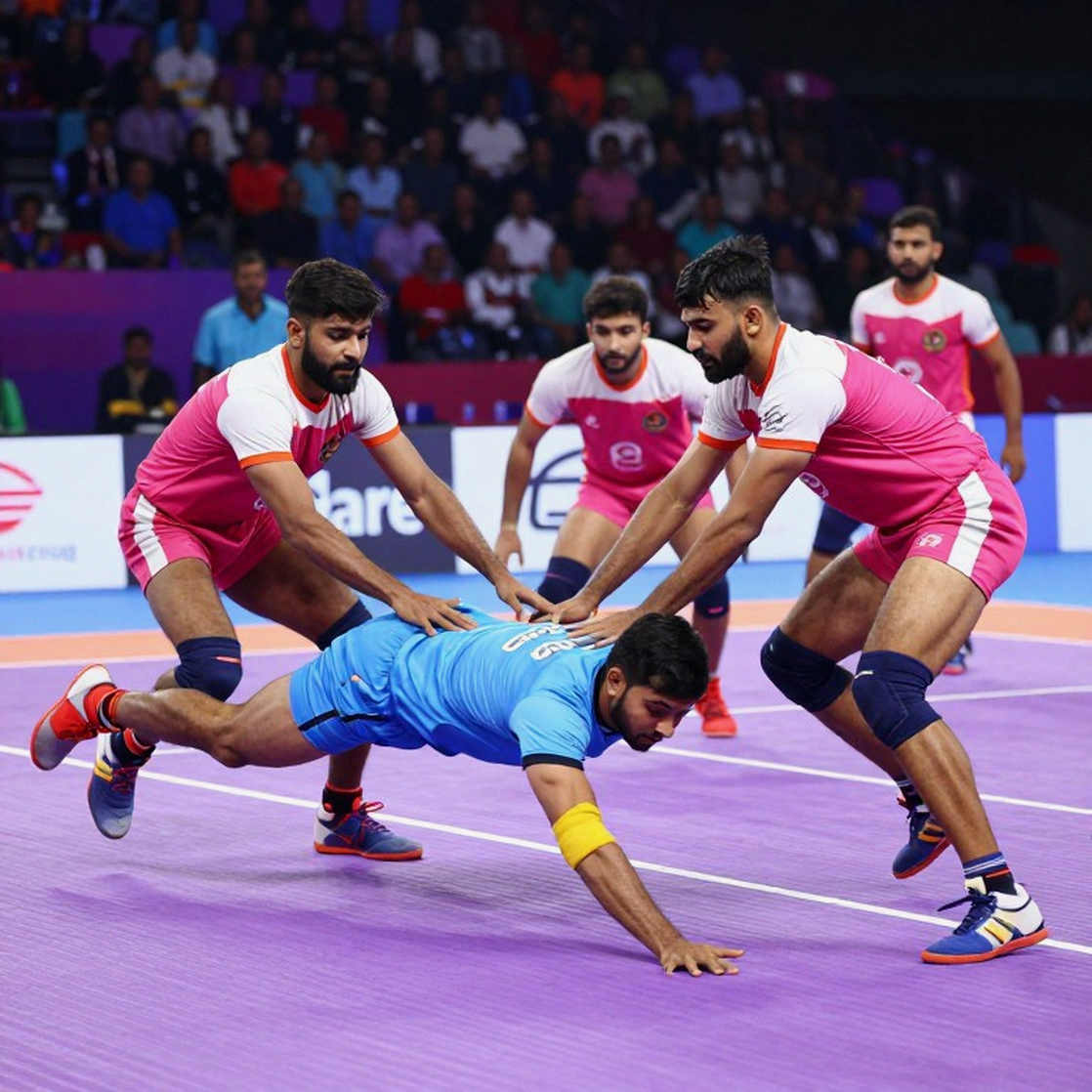
The roles have been divided cleanly. Surjeet Singh is entrusted with organising the team on the mat and maintaining defensive discipline; Naveen Kumar is framed as the head of India's raiding department. That split is technically coherent — it is, in fact, the standard Pro Kabaddi League template — but the report presents it as a journalistic label rather than a rule-based argument, and it leaves several substantive questions unanswered.
First, the Rules
For readers unfamiliar with the sport: kabaddi is a seven-a-side contact sport played on a 13m × 10m court. One player at a time crosses into the opposing half while holding his breath and must return safely for any touch to count. It is India's second-most-watched sports property after cricket, and the Pro Kabaddi League is the world's only commercially mature kabaddi league.
Raid — the offensive act. The raider crosses into the opponent's half within a 30-second limit, touches one or more defenders, and must return to his own half.
Cant — the raider must continuously chant 'kabaddi, kabaddi' throughout the raid as proof he is not inhaling. If the chant breaks, the raid is void and the raider is out.
Tackle — the defending side collectively stops the raider inside their own half. The defenders score; the raider is out.
All Out — when every player on one side has been ruled out, the opponent earns two bonus points and the eliminated team returns to court. This is kabaddi's team-wipe reset and the main engine of comeback swings.
Bonus Line — a line deep in the opponent's half. Crossing it earns one point, but only when the defending side has six or more players on court.
Do-or-Die Raid — after two consecutive empty raids, the third becomes mandatory-scoring. If it fails, the raider himself is out.
Super Tackle — a tackle made with three or fewer defenders on court, worth two points instead of one.
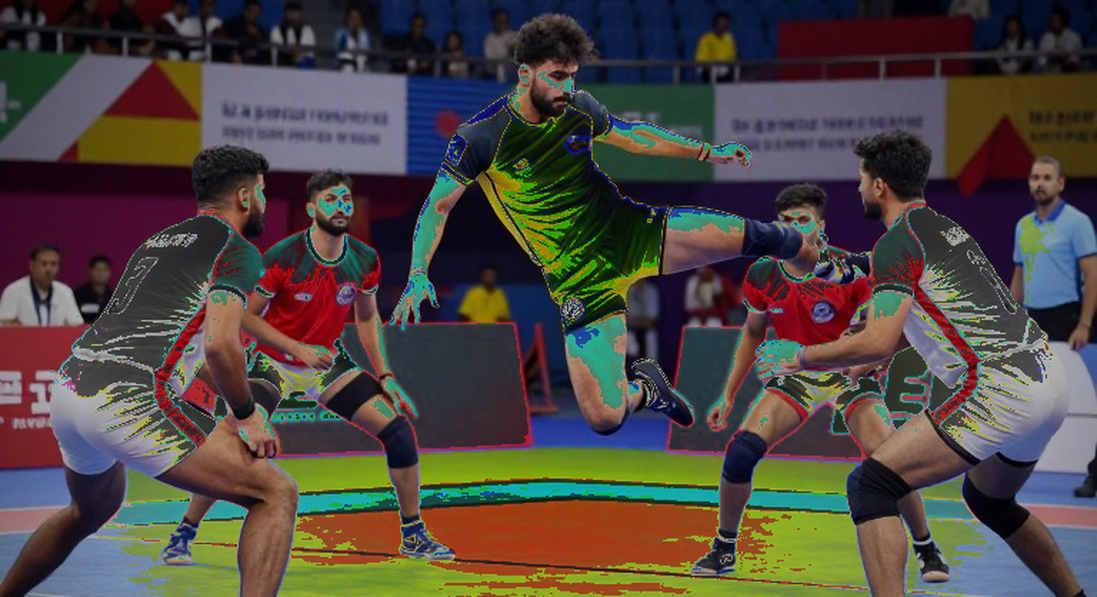
Super Raid — a single raid scoring three or more points.
The net effect is granular, fast scoring. A raid lasts 30 seconds, the court is small, and points accumulate constantly — which is precisely why kabaddi works so well on television.
The Format Gap
Here the announcement's central technical weakness becomes visible. It does not state the tournament format: how many nations are participating, whether there is a group stage, how many matches will be played. For a nine-day event, this is not a minor omission — it is the foundation on which every other assessment rests.
In a compact group-stage format, All Out swings dominate and a single upset can change the outcome. In a longer round-robin, depth, fitness and injury management become decisive. The captain's workload differs in each case. Without the format, no claim about Surjeet Singh's tactical burden is quantifiable. Substitution and review rules are also undisclosed — and PKL-style rolling substitutions materially change captaincy calculus, because the captain can then control which raider is on the mat and when.
The Captaincy Structure
Captaincy in kabaddi is more operational than in most team sports. Because play resets every 30 seconds, the captain's real job is in-court micro-decision-making: when to call a time-out, how to manage Do-or-Die risk when the team is down to four or five players, when to deliberately concede a point to reset an All Out threat, and how to direct corner-cover alignment in live play.
A defender-captain plus raider-vice-captain pairing is the standard template, and it is rationally structured. During the opponent's raid, the defender-captain faces the whole court — the best tactical vantage point available. The raider-vice-captain controls the tempo of his team's own scoring phases. India has followed that structure, and in this sense the decision is sound.
But the announcement does not argue it from the rules. It simply asserts that Surjeet has defensive experience and Naveen has attacking ability. The real competitive logic lies in court-side decision authority and defensive alignment, neither of which is explained. There is also a known trade-off: a defender-captain offers excellent structural organisation and defensive communication, but weaker influence over the raider's in-raid decision-making, since he is physically on the other side of the mat during his team's raids. Giving the vice-captaincy to the lead raider is a sensible mitigation of exactly that gap — and is the one genuinely strong design choice visible here.
Player Assessment
Naveen Kumar is described as the player who will anchor India's raiding department, and whose individual raids can shift momentum. This is the article's only quasi-tactical statement and it is generic: momentum-shifting raids are the definition of a lead raider's job. He is publicly known as a high-volume, high-efficiency PKL raider, particularly strong in Do-or-Die situations — which is almost certainly the real reason for his appointment, not the generic language used. But the report supplies no raid points, no success rate, no match count, no Do-or-Die conversion figure. Not one number.
Surjeet Singh is charged with organising the team on the mat, maintaining defensive discipline, and responding to opponents' attacking threats. His framing is explicitly that of a defensive organiser rather than a scoring captain. There is, however, a genuine identity problem: Surjeet Singh is a common Indian name shared by more than one professional kabaddi player. The announcement supplies no PKL franchise, no home state, and no position on the mat. For a national-captain announcement, that is a notable reporting failure — readers have no way to anchor the identity.
The squad is not published. Only two names out of a probable 12–14-man squad have been revealed. No all-rounder, no second raider, no corner defenders, no goalkeeper-role player. For a squad-level preview this is a substantial omission, because team strength lives in depth, not in two names.
Single-point raiding dependence is a structural risk the report neither names nor examines. If Naveen Kumar is the raiding department, the obvious question — who is the second raider, and what happens if he is tackled out or injured — is left entirely unanswered. In kabaddi, a raider-only offence collapses the moment the lead raider is worked over by a chain-tackle scheme. A skilled defensive unit needs only two or three raids to read a raider's preferred line.
The Competitive Landscape
The field looks like this: India as overwhelming favourite; Bangladesh, Pakistan, Sri Lanka, Malaysia and Singapore as mid-tier challengers; England, Kenya, Australia and Canada in a development tier; and Iran absent.
The single most consequential structural fact about this event is one the article never mentions: Iran is not a Commonwealth member. Iran is the only nation to have broken India's men's Asian Games gold run, in 2026, and is the sport's sole established challenger at Standard Style. Its absence means this tournament — however it is branded — is one India enters as a heavy favourite against a field drawn largely from South Asian Commonwealth states plus diaspora-based teams. That does not make it a bad event, but it caps its value as a competitive benchmark, even if it retains value as a development and soft-power platform.
There is also a factual contradiction. The report calls the event inaugural while stating India will enter to win back-to-back titles. An inaugural edition cannot be won back-to-back. Either the author conflated consecutive international titles, or a prior edition of a similarly named event exists that the report failed to disclose. Either way, the claim is unreliable as written.
Finally, 'Commonwealth' here is a governance frame, not a competitive one. Kabaddi has no meaningful grassroots presence in most Commonwealth nations, so a Commonwealth championship selects for political membership rather than sporting depth. And note: this event is not on the Commonwealth Games programme — kabaddi is not a CWG sport, and Glasgow 2026 does not include it. The word signals affiliation branding, not a CWG pathway.
Calendar Collision
Kabaddi has been a medal sport at the Asian Games since 2026 and remains India's priority national-team target. The 2026 Asian Games in Aichi–Nagoya fall in September–early October 2026. The Commonwealth Championship sits roughly three weeks later. Meanwhile the PKL season has historically run October–December, so an Ahmedabad event on 23–31 October would likely collide with PKL pre-season or the early league phase, creating a player-release conflict between franchise and country.
Together these factors suggest the federation may use this event as a low-risk blooding opportunity for fringe and second-line players rather than a full-strength selection. If so, the captaincy carries developmental rather than first-choice significance.
Regional and Cultural Context
Ahmedabad is not a traditional kabaddi talent heartland in the way Haryana or Maharashtra are, but it is a major arena market with an established PKL franchise footprint and strong state-level infrastructure. Hosting an inaugural international event there is a market-development decision — build a new audience — rather than a talent-development one.
Kabaddi's social narrative in India is fundamentally a class-mobility story: the sport draws overwhelmingly from rural, low-income families, and a professional contract is a route out of agricultural or informal labour. A national captaincy announcement in Indian media therefore usually carries an implicit 'village to national team' arc. Notably, this report does not use that arc at all, which is unusual for the genre and suggests it was written quickly off a federation press release rather than from original reporting.
'Commonwealth' also carries a specific post-colonial resonance in India distinct from its competitive meaning. Branding a traditional Indian sport as a Commonwealth discipline positions kabaddi as an export — India as the sport's proprietor rather than a participant. It is soft-power positioning, and it is deliberate. But it will not on its own generate an international audience, because kabaddi's overseas base outside the South Asian diaspora is genuinely thin.
The Women's Competition
The most substantively positive detail in the announcement is that the tournament includes a women's draw alongside the men's. And the report gives it one sentence: no captain, no squad, no format, no opponents — while devoting four paragraphs to the men's leadership pair. That asymmetry is itself a data point about how the Indian kabaddi media ecosystem still treats the women's game. It also matters commercially, because the PKL has no women's league. A women's draw at an international event creates a small but real competitive pathway that exists nowhere else. That is the event's clearest structural contribution, and one sentence is not enough.
The Commercial Picture
Event-level commercial health cannot be assessed, because no commercial information appears in the announcement. No broadcaster, no sponsor, no player salary or appearance fee, no sanctioning body. That last omission is material: without knowing whether the event sits under the IKF or an affiliated Commonwealth kabaddi body, its prestige cannot be graded. Media coverage value is moderate domestically — a national captaincy is a standard news peg — while international rights value outside the Indian diaspora is near zero.
What Is Missing
The checklist is stark. Captain and vice-captain: available. Venue and dates: available. Full squad, player positions, tournament format, participating nations, match schedule, substitution rules, sanctioning body, broadcaster and sponsors, women's captain and squad, and any performance statistics whatsoever: all unavailable.
That list explains itself. This is a news peg, not an analysis.
Conclusion
The Surjeet Singh–Naveen Kumar pairing is correct by kabaddi's technical logic. A defender-captain sees the whole court, makes decisions at every 30-second reset, and handles defensive alignment. A raider-vice-captain manages his team's scoring tempo and compensates for the captain being on the other side of the mat during raids. This is the PKL template, and it works.
But the reporting does not rise to the quality of the decision. Five basics are absent: the full squad, the players' positions, the tournament format, the list of participating nations, and any performance data at all. Without them, phrases like 'combining defensive organisation with effective raiding' are assertions, not analysis.
Three questions are specifically unanswered and answerable. First, who is Surjeet Singh — which franchise, which state, which position. A national-captain announcement should settle that. Second, who is the second raider, and what is the depth of the raiding department — single-raider dependence is the most easily broken structure in kabaddi. Third, what is the tournament format, because without it the captain's tactical burden cannot be estimated.
And one structural point belongs at the top: Iran's absence. This is not a genuine competitive test for India; it is a development and soft-power platform. It should be assessed as such, not as proof of Indian kabaddi's competitive supremacy — and that is precisely the distinction the announcement blurs.
India will take the mat in Ahmedabad on 23 October with Surjeet Singh as captain and Naveen Kumar as vice-captain. The missing information should surface before the tournament begins. If it does not, that silence will itself be a signal about how seriously this inaugural event is being treated.