
Asian Champions Trophy: Strong in all quarters, India thrash China 5-2
**मुख्य उत्तर:** भारत ने एशियाई चैंपियंस ट्रॉफी के राउंड-रॉबिन मुकाबले में चीन को 5-2 से हराया। मैच भुवनेश्वर के ओलंपियन सुरजीत सिंह हॉकी स्टेडियम में खेला गया। **स्कोरर:** हरमनप्रीत सिंह (2 गोल, पेनल्टी कॉर्नर), सुखजीत सिंह (2 गोल, ओपन प्ले), जुगराज सिंह (1 गोल)। **मुख्य आंकड़ा:** भारत के 5 में से 3 गोल पेनल्टी कॉर्नर से आए — यानी 60 प्रतिशत, जो अंतरराष्ट्रीय औसत (30-50 प्रतिशत) से ऊपर है। **चिंता का बिंदु:** घर में निचली रैंकिंग वाली टीम के खिलाफ 2 गोल खाना; हाफ-टाइम से 4 मिनट पहले चीन ने बराबरी की थी। **प्रश्न: क्या यह जीत भारत की वैश्विक स्थिति का पैमाना है?** नहीं। प्रतियोगिता में ओलंपिक कोटा नहीं है (पुरुष हॉकी में सीधा कोटा एशियाई खेलों के स्वर्ण विजेता को), रैंकिंग अंक सीमित हैं, और दोनों प्रतिद्वंद्वी निचले स्तर के थे। **प्रश्न: भारत की अगली परीक्षा क्या है?** पेनल्टी कॉर्नर की वास्तविक दक्षता (जीते गए कॉर्नर उपलब्ध नहीं), ओपन प्ले से गोल का अनुपात बढ़ाना, और रक्षात्मक किफायत सुधारना। **टीम स्थिति:** भारत छह टीमों की तालिका में शीर्ष पर, लगातार दूसरी जीत; पिछले मैच में बांग्लादेश को 13-0 से हराया था। मुख्य कोच: क्रेग फुल्टन।
Bhubaneswar: India beat China 5-2 in the round-robin stage of the Asian Champions Trophy at the Olympian Surjit Singh Hockey Stadium, with captain Harmanpreet Singh scoring twice, Sukhjeet Singh adding a brace and Jugraj Singh chipping in with one. It is India's second successive win of the tournament and puts them at the top of the six-team table.
The scoreline is comfortable, but the match was not as one-sided as the margin suggests. India had hammered Bangladesh 13-0 in their opener — an outlier result with almost no diagnostic value. The China fixture was a more serious test, because China are a better side than Bangladesh, they entered India's circle, scored twice and drew level once. That is why the score needs to be read alongside the process, not instead of it.
The flow of the match
India dominated possession from the start. China sat in a deep block and looked to counter. India took the lead, but four minutes before half-time China equalised. That was the moment the match could have turned. Conceding an equaliser at home, against a lower-ranked side, just before the interval is a process signal rather than a cosmetic detail.
What followed, however, is the clearest evidence of India's biggest strength. Barely a minute after the equaliser, Harmanpreet Singh converted a penalty corner to restore the lead. The timing was not a coincidence — scoring immediately after conceding is the skill that wins knockouts, because it breaks the opponent's momentum while keeping your own structure intact.
Right after the restart, Harmanpreet scored again. That moment is arguably more important still. The four-quarter format has given coaches three natural adjustment windows — after Q1, at half-time and after Q3. Using those windows to strike immediately is one of the modern game's biggest weapons, and India's first attacking sequence out of the dressing room produced a goal.
Sukhjeet's brace and the second flicker
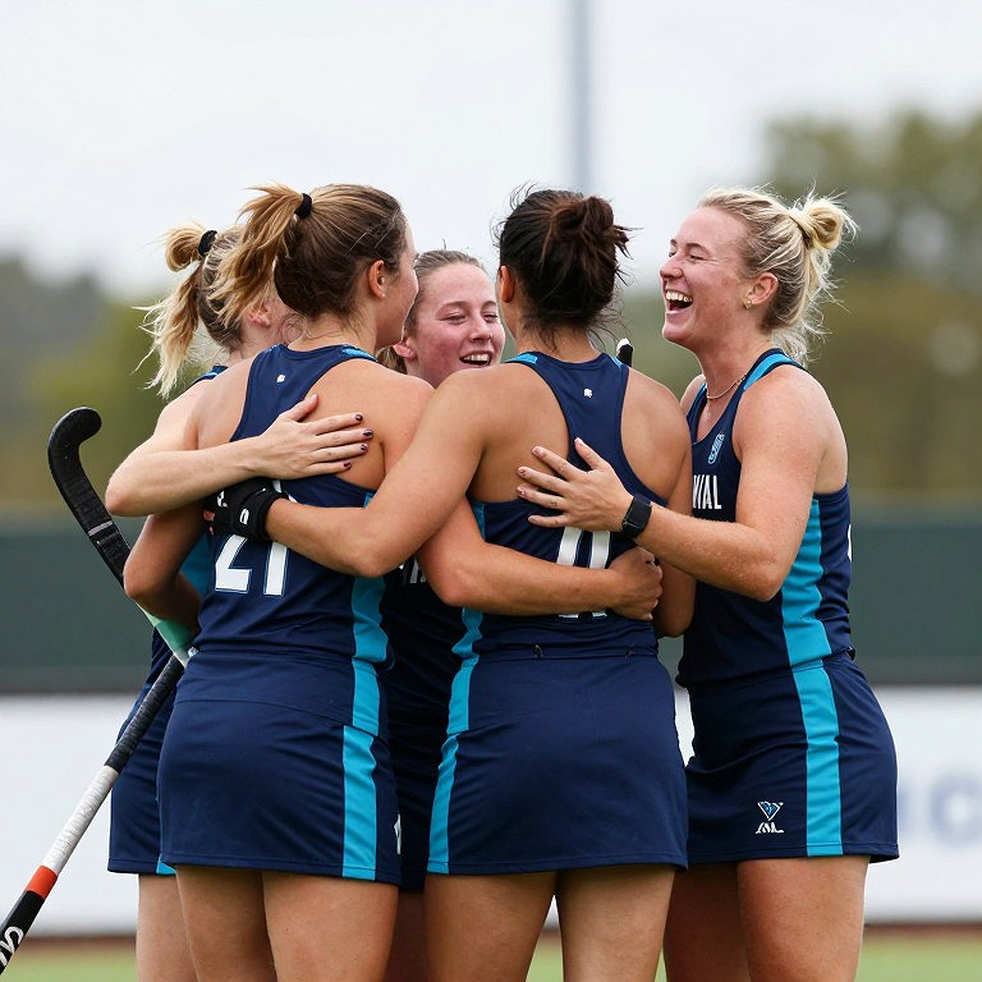
Three of India's five goals came from penalty corners and two from open play; both field goals were scored by Sukhjeet Singh. That detail matters. On one hand, it shows India's attack is not wholly set-piece dependent — Sukhjeet converted chances created in general play, which is the real test of an open-play forward. On the other hand, three of five goals from PCs is a warning in itself.
Jugraj Singh's goal carries a different signal. Jugraj is a defender who also takes drag flicks. His presence on the scoresheet implies India used a multi-flicker option. That is standard practice at elite level: once the first runner starts reading Harmanpreet's timing, a second flicker changes the defensive calculation. It also suggests India's corner pool rests on a system rather than a single individual.
Three of five: the 60 per cent penalty-corner share
This is the clearest and most discussed number of the match. Sixty per cent of India's goals came from penalty corners, against a typical international band of 30 to 50 per cent. Technically that is strong; strategically it is the red flag that winning scorelines tend to hide.
The reason is simple. A team sourcing three-fifths of its goals from set pieces is being kept alive by one specific defensive habit from the opponent — fouling inside the circle. Belgium, the Netherlands and Australia concede far fewer circle fouls. Against them, the corners will not arrive in the same volume, and on the day they do not arrive, you need a habit of scoring from open play. That is precisely the area this match's data shows least clearly.
There is a bigger problem: corner efficiency cannot be assessed at all. The number of corners India won is not in the available record. Three goals from twelve corners is 25 per cent — below average. Three from four is 75 per cent — world class. Both produce an identical goal count and completely opposite technical verdicts. Any statement about PC efficiency without the number of corners won is incomplete.
A plausible hypothesis is that Asian opponents defend deep against India and foul early in the circle, inflating corner volume. If so, three goals may actually point to moderate rather than elite efficiency, and the 60 per cent share is less impressive than it looks. That remains a hypothesis, not a finding.
Two conceded: the most informative number
The most informative number in this match is not five but two. India conceded twice at home, in front of their own crowd, on their own surface, against a lower-ranked Asian side. For a top-five team the normal expectation in such a fixture is zero to one. Two concessions are a process signal, not scoreline decoration.
The difficulty is that the available record does not say how the goals came. Open play, penalty corner, or a broken press leading to a counter? Each has a completely different meaning. Goals from PCs would point to discipline rather than structure. Goals from open play would demand a review of the back line and the goalkeeper unit. Goals from counters would suggest India's full-backs are pushing too far forward in possession — the known trade-off of the Fulton-style build-up.
One thing can be said: China's equaliser came four minutes before half-time. Conceding late in the first half often indicates that a team deliberately eased its press to preserve energy before the break. In a six-team round robin with matches roughly every 48 hours, that can be a rational rotation decision. But it is only an inference, because no process data is available.
Four quarters and the Fulton template
Craig Fulton's coaching background comes from the Irish and Belgian structured school — organised blocks, disciplined transitions and controlled reliance on set pieces. What India are showing is that structure blended with individual Indian flair. It is not an innovation; it is a hybrid.
The model's strongest feature is that it treats in-match breaks as a weapon. The four-quarter format provides three adjustment windows, and India exploited at least two of them directly here — one minute after conceding and immediately after the break. That suggests a team drilled specifically for restart situations. It is a coach's imprint, not the scoreline's.
An honest limit applies: this is one match. Scoring at the right moment twice in a single game may indicate a good habit, but statistically it is an observation, not a pattern. Proving it needs four or five matches, against varied opposition quality.
What the data does not show
The biggest constraint on this report is that almost nothing beyond goals is available: no possession share, no shot count, no circle entries, no corners won, no mention of green or yellow cards. Without them, any process-based conclusion must be stated cautiously.
That does not mean nothing notable happened. It means the source report was brief — most likely a short agency-style dispatch carrying scorers and the score, not the underlying detail. Readers should know that the analysis here rests on a limited base, and that where inference is used it is labelled as such.
What this tournament is actually worth
The Asian Champions Trophy is a continental six-team round robin. India top the table after two matches. But the event carries no Olympic qualification. In men's hockey the direct Olympic ticket goes to the Asian Games champion, and the world-ranking points on offer here are modest.
A defeat in this tournament would therefore cost India almost nothing structurally — and that is its most interesting feature. When result pressure is low, the real test is behavioural: rotation, discipline, experimentation. Did the coach rest key players in the 13-0 win over Bangladesh? Were new penalty-corner variations rehearsed? Did younger players get minutes in the third and fourth quarters? The available record does not answer any of these, and that is this report's largest evidence gap.
In table terms, the 13-0 has one concrete function: goal difference. In a six-team round robin, semi-final seeding is partly decided by goal difference. India's top position is partly manufactured by that result, not solely by quality. That needs acknowledging, because the line 18 goals scored and two conceded across two matches creates a misleading picture on its own — 13 of those 18 came against the weakest side in the field.
Hosting also carries structural meaning. Staging the event in Bhubaneswar reflects the activity of Odisha's state-sponsored hockey model: an international-standard water-based surface, an existing spectator base and zero travel fatigue. Most Asian federations cannot assemble that hosting capacity. It is a signal of strength, not just logistics.
Where India stand globally
The current global order has the Netherlands, Belgium, Australia and Argentina in the front rank. India sit at the upper end of the second rank — medal challengers, not title contenders. This match does not change that classification.
Beating China 5-2 and Bangladesh 13-0 confirms superiority in Asia; it says nothing about closing the gap to the European and Australian top four. Where is the gap? Two places: open-play conversion rate and defensive economy. In this match 60 per cent of goals came from penalty corners and two were conceded. Those are exactly the two variables that separate medal challengers from title contenders.
One further point should be made plainly. Labelling this team a golden generation would be premature. The available evidence points to a captain-anchored, system-driven side with one world-class set-piece specialist. The correct description is a structured team with an elite penalty-corner weapon — which is not a small thing, but it is not yet a title claim.
Three different scorers featured here, which is a positive signal: the attack does not depend entirely on one individual. The dependency is on the set piece, not the person. The distinction is small but important, because set-piece dependency can be reduced with a second flicker and new variations, while dependence on a single player cannot.
Management, rotation and what comes next
Team management is stable: a centralised national-camp model, a foreign head coach and an established captain. With matches roughly every 48 hours in a six-team round robin, rolling-substitution depth is being genuinely tested. Managing the minutes of key players in a 13-0 fixture was the most important question of the week — and the record does not answer it. If a player like Harmanpreet played a heavy share of that match, it would be a management warning sign. For now the only honest statement is that the information is insufficient.
Disciplinary data is equally absent. In hockey, a two-minute green or a five-to-ten-minute yellow is the single biggest swing variable in a match; losing one player reshapes the entire structure. No card or referral is mentioned here, which can be read positively — but the absence may simply reflect missing information.
Three things are worth watching. First, how many penalty corners India win in the coming matches and at what conversion rate — that will reveal true efficiency. Second, whether the open-play share of goals rises, particularly against opponents who foul less. Third, whether India can still land a blow immediately after the break against stronger opposition.
Conclusion
The 5-2 win is a good one, the dominance is real, and the table position is deserved. But this match is not a yardstick for India's global standing. The Asian Champions Trophy's value is internal: testing rotation, bedding in penalty-corner variations, building squad cohesion. Reading the direction of an Olympic cycle from these two results would be a category error.
A team that claims dominance in every quarter must also explain why it was level four minutes before half-time, and how a host side conceded twice. Belgium and the Netherlands will not forgive those lapses.
Key facts
Match: India 5-2 China, Asian Champions Trophy, round-robin stage, Olympian Surjit Singh Hockey Stadium, Bhubaneswar. India scorers: Harmanpreet Singh (2), Sukhjeet Singh (2), Jugraj Singh (1). Goal distribution: 3 penalty corners, 2 open play. Second successive win; top of the six-team table. Previous match: 13-0 vs Bangladesh. Head coach: Craig Fulton. Captain: Harmanpreet Singh.